Identify the actual chemical
List acids, alkalis, solvents, oxidizers, stains, disinfectants and cleaning chemicals that may reach the floor. Avoid using “acid resistant” or “solvent resistant” as a substitute for the real reagent name.



 Commercial Vinyl Flooring Supply
Chemical resistant vinyl flooring should be specified around the actual chemicals used in the room—not around a generic “chemical resistant” claim. 3C-Floor supplies commercial PVC sheet flooring for laboratory, pharmaceutical and controlled interior projects, with homogeneous roll options, weldable seams, project colors and specification support. For serious laboratory PVC flooring procurement, buyers should define reagent type, concentration, spill duration, disinfectants, rolling loads, seam details and any ESD requirement before approving the floor.

A floor can perform well against one acid or disinfectant and still be unsuitable for another solvent, concentration or exposure duration. Laboratory flooring decisions become safer when the procurement team converts the room’s chemical use into a defined compatibility matrix before material approval.
List acids, alkalis, solvents, oxidizers, stains, disinfectants and cleaning chemicals that may reach the floor. Avoid using “acid resistant” or “solvent resistant” as a substitute for the real reagent name.
A brief splash and a pooled spill are different exposures. Concentration, temperature, frequency and the time before cleanup can materially change compatibility.
Ask for data for the exact product construction and the project-required test method. ISO 26987 and ASTM F925 are commonly referenced chemical-resistance methods for resilient flooring, but the project specification should determine what is required.
Quick answer for specifiers: laboratory PVC flooring is a strong candidate when the room needs a cleanable resilient sheet surface, reduced joint density, heat-weldable seams and documented resistance to the chemicals actually used. It should not be treated as universally resistant to every laboratory reagent.
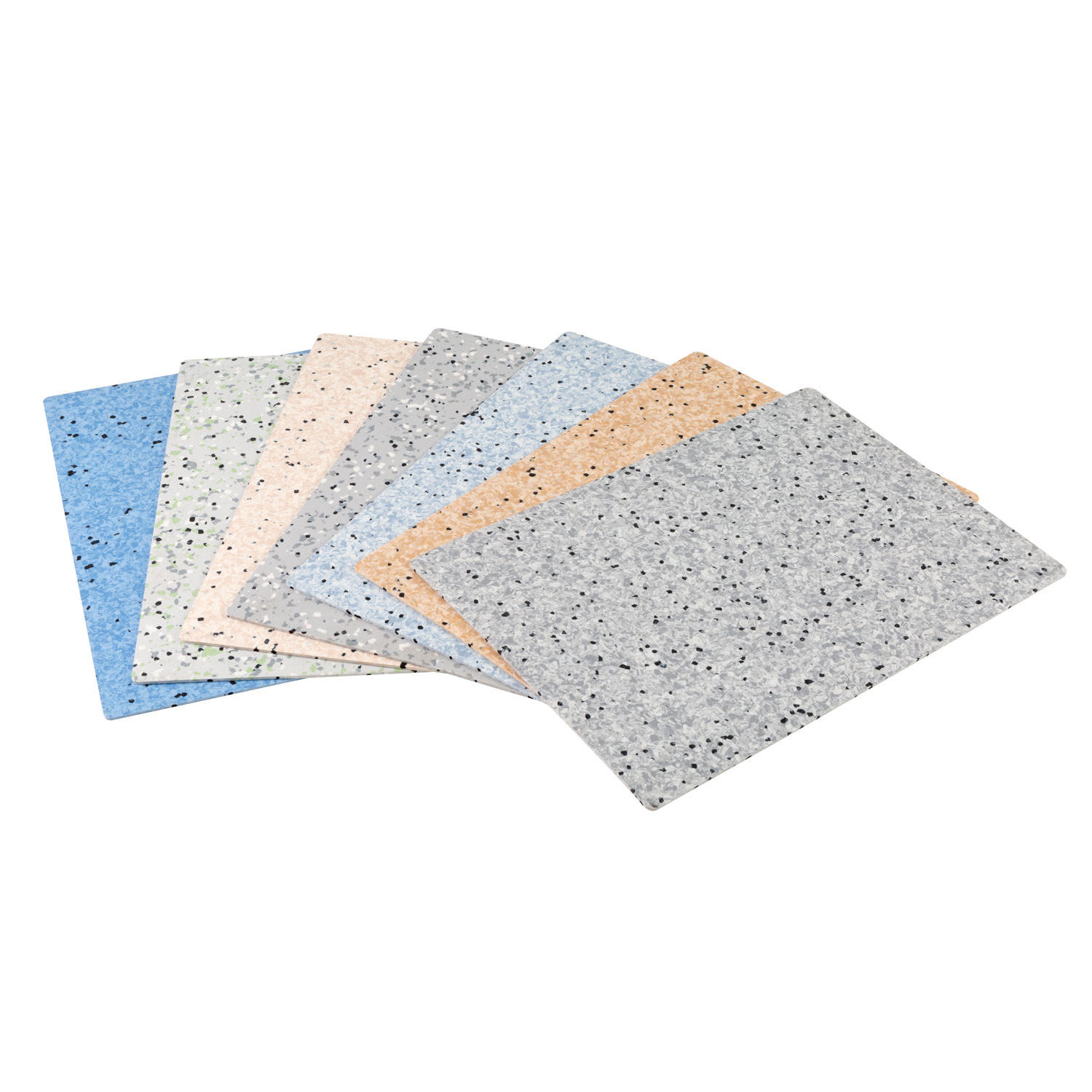
For buyers who want a through-body commercial sheet structure, review 3C-Floor’s homogeneous PVC flooring range as the product-family starting point, then narrow the specification according to the room’s exposure profile.
Thickness matters, but it does not define chemical resistance by itself. A complete specification connects material structure, treated surface, chemical data, seams, adhesive, subfloor, traffic and cleaning procedure.
| Specification Item | 3C-Floor Project Direction | What the Buyer Should Confirm |
|---|---|---|
| Flooring type | Homogeneous PVC sheet is a practical first choice for many laboratory and pharmaceutical interiors. | Room classification, traffic, cleaning system, chemical exposure and whether a specialty ESD floor is required. |
| Typical thickness | Approximately 2.0–3.0 mm within relevant 3C-Floor homogeneous vinyl programs; final availability depends on the selected construction. | Project specification, rolling loads, substrate condition and exact technical data sheet. |
| Roll width | 2 m is common in the current homogeneous/PVC roll product range. | Room dimensions, seam map, roll yield and batch planning. |
| Surface treatment | PUR / UV-treated options are available within relevant commercial vinyl programs. | Cleaning chemicals, stain exposure, maintenance protocol and exact surface system. |
| Chemical resistance | Project-selected; never assume one resistance statement covers every chemical. | Reagent name, concentration, exposure time, temperature and required standard/test report. |
| Seams | Heat-welded seam detailing is available for compatible sheet systems. | Matching welding rod, groove/weld method, installer competence and perimeter details. |
| Installation | Full-spread glue-down is the normal commercial sheet approach. | Subfloor flatness, slab moisture, adhesive chemistry, room conditions and handover timing. |
| Static control | Standard resilient sheet and ESD flooring should be treated as different specification paths. | Required electrical resistance range, grounding system and applicable facility standard. |
| Color / OEM | Project colors and custom flooring directions can be discussed. | Approved sample, batch reference, zoning plan, replacement strategy and private-label needs. |
For broader sheet constructions and roll planning, see the verified PVC flooring roll material range. Exact product data should be confirmed against the final sample and technical sheet before tender submission or bulk order approval.
Homogeneous vinyl flooring carries a consistent material composition through the body rather than relying on a decorative printed layer over a different base. For many laboratory and pharmaceutical projects, that makes it a practical structure to evaluate where heavy traffic, routine cleaning, repairability and welded joints matter.
The roll format also reduces joint density compared with small tiles or planks. Where the project requires sealed joints, compatible vinyl floor welding rod becomes part of the installation system—not an accessory to decide after the flooring arrives.

A useful RFQ does not ask whether the flooring is “chemical proof.” It identifies the substances and operating conditions that the material must survive, then asks the supplier to match the correct product and available test documentation.
List each reagent, concentration and whether exposure is a splash, routine spill or prolonged contact.
Specify alcohols, ketones, hydrocarbons or other solvents individually. Solvent exposure often requires more careful compatibility review.
Include peroxide-type agents, iodine-related stains and any process chemicals known to discolor resilient surfaces.
Routine disinfectants can be more frequent than accidental spills. Their dilution and cleaning cycle belong in the specification.
“Acid resistant,” “anti-corrosion” and “chemical resistant” are useful product directions but incomplete specifications. Ask for the exact product’s resistance data and confirm that the test conditions reflect the real laboratory or pharmaceutical process.
The same PVC sheet can be a good fit for one room and a poor fit for the next. Room function should determine the approval path.
Prioritize reagent compatibility, rapid spill cleanup, cleanable welded seams, rolling-load resistance and visibility of contamination. Strong solvents or concentrated chemicals need specific verification.
Focus on repeatable cleaning, decontamination chemistry, reduced joint density, coved perimeter details where specified, controlled color zoning and project documentation. “Pharmaceutical flooring” does not become sterile by itself; it must support the facility’s cleaning protocol.
Durability, cleanability and selected chemical resistance may be more important than expensive specialty features. Do not automatically specify ESD performance unless the equipment or safety plan requires it.
Combine stain and disinfectant compatibility with welded seams, rolling equipment loads and easy routine maintenance. For hygiene-led room planning, compare the dedicated antibacterial vinyl flooring guidance.
If sensitive electronics or electrostatic discharge control is part of the process, chemical resistance alone is insufficient. Review a dedicated anti-static flooring system and define electrical performance separately.
Large roll widths, welded joints, cleanability, cart traffic, color zoning and transitions often dominate the decision. A corridor may need different slip or rolling-load performance than the adjoining lab.
Information gain matters in procurement: a supplier should help buyers reject the wrong flooring, not only promote its own material.
| Project Condition | Homogeneous PVC Sheet | Heterogeneous PVC Sheet | Resinous / Poured Floor |
|---|---|---|---|
| Frequent foot traffic and routine cleaning | Strong candidate | Strong candidate where a layered visual construction is preferred | Also suitable depending on system |
| Need fewer joints over large rooms | Strong candidate with welded seams | Strong candidate with welded seams | Monolithic poured finish can provide no sheet joints |
| Broad decorative visuals | More limited / pattern-led | Usually broader visual flexibility | Color and broadcast systems vary |
| Known laboratory chemicals | Verify exact chemical matrix | Verify exact wear surface and chemical matrix | Verify resin chemistry against exact exposure |
| Prolonged aggressive solvent pooling | May not be appropriate without product-specific evidence | May not be appropriate without product-specific evidence | Often considered when a specially formulated resin system matches the exposure |
| Thermal shock / heavy industrial abuse | Not the default choice | Not the default choice | Specialized resin systems may be more appropriate |
Decision rule: choose the flooring system by the worst credible operating condition. If the room faces unusually aggressive chemicals, thermal shock, long-duration pooling or industrial impact, ask whether a specialized resin system is more appropriate before forcing a vinyl specification.

A chemical-resistant top surface is only one layer of the system. If liquid reaches an open seam, poorly sealed perimeter or incompatible adhesive zone, the project can fail even though the PVC itself resists the spill.
Plan roll direction and seam locations around benches, doorways, equipment and high-risk spill zones. Fewer seams are useful, but seam placement is equally important.
Pharmaceutical and controlled environments may require an integral or formed cove concept to simplify perimeter cleaning. Confirm the wall-floor detail with the project designer and installer.
The adhesive must suit the substrate, PVC construction, moisture condition and operating environment. Chemical resistance of the sheet does not automatically prove the adhesive is compatible with every spill.
Moisture assessment and substrate preparation remain critical for fully adhered sheet flooring. Project failures frequently start below the visible wear surface.
For distributors, contractors and project buyers, repeatability matters as much as the first sample. A useful approval package freezes the floor structure, thickness, surface, color reference, roll format, welding material, packaging and required test documentation before bulk production.
Approve color and surface together with the relevant technical data. Do not approve a color chip and assume every performance option uses the same construction.
Plan room quantities, cutting yield and spare material so critical areas can be installed from controlled production references and future replacements can be managed.
Importers can discuss color, specification, labeling and packaging requirements through 3C-Floor’s custom vinyl flooring program.
Do not assume every certificate, fire classification, VOC result, slip result, antibacterial test or chemical-resistance report applies to every PVC flooring construction. Send the required standard with the inquiry so 3C-Floor can confirm whether the selected product program has the necessary supporting documentation.
“Chemical resistant” without reagent, concentration and contact time is not enough for technical approval.
A surface that cleans easily after common stains may still react differently to aggressive laboratory chemicals.
Open joints can undermine cleanability and allow liquid migration even when the sheet surface performs well.
Static-control flooring should answer a defined process risk. It adds a separate electrical system that must be designed and verified.
Corridors, wet-cleaning areas, instrument labs and production rooms can require different slip, load, chemical or static performance.
Freeze the construction and supporting documentation—not only color—before placing a project or wholesale order.
Selected commercial vinyl flooring can resist many commonly encountered chemicals and staining agents, but chemical resistance is not universal. Verify the exact flooring construction against the actual chemicals, concentrations, contact times and cleaning agents used in the laboratory.
Homogeneous PVC sheet is often a practical starting point because its compact through-body construction, large roll format and weldable seams support heavy use and easier cleaning. Final selection must still consider chemical exposure, rolling loads, slip requirements, static control and project standards.
A pharmaceutical flooring specification should address surface cleanability, seam welding, coving details where required, chemical and disinfectant compatibility, traffic and rolling loads, slip performance, subfloor conditions, adhesive compatibility, color zoning, required test documentation and any ESD requirement.
Heat-welded seams are commonly specified in laboratories and pharmaceutical interiors when the project needs fewer open joints and easier cleaning. Seam welding does not replace correct subfloor preparation, adhesive selection or perimeter detailing.
No. ESD flooring should be specified when the process, instruments, electronics or safety plan requires controlled electrical resistance. General chemical or teaching laboratories may not need a dedicated ESD system.
A resinous system may be a better fit where the floor must tolerate unusually aggressive chemicals, prolonged pooling, thermal shock, heavy industrial impact or a fully monolithic poured finish with drains and complex slopes. The exposure profile should determine the system rather than the material name alone.
Send the room type, total area, chemical and disinfectant list, concentration and likely contact time, traffic and rolling loads, ESD requirement if any, thickness or project specification, color direction, quantity, required test standards, packaging needs and destination port.
3C-Floor can review a laboratory PVC flooring or pharmaceutical flooring direction more effectively when your RFQ describes the real operating environment. The goal is to match the product structure and documentation to the exposure—not to force one generic vinyl sheet into every room.
Request a Laboratory Flooring Review