Welcome to 3C-Floor — Your Trusted Manufacturer of SPC Flooring, WPC Vinyl Flooring, LVT Flooring & PVC Flooring Rolls.
  • 0086 13321818576 (Steven Lee)
News
Current Location:Home > News

Cleanroom Flooring for Semiconductor & Electronics | 3C-Floor

Update:2026/9/11 16:43:24 Views:2
Cleanroom · ESD · Controlled Environment Flooring

Cleanroom Flooring for Semiconductor, Electronics & Data Center Projects

Cleanroom flooring should be specified as a complete controlled-environment floor system, not as a generic “anti-static” surface. For semiconductor flooring, electronics factory flooring and data center anti-static floor projects, 3C-Floor can support ESD vinyl sheet and conductive/static-dissipative flooring directions with homogeneous constructions, roll formats, project colors and specification coordination. The correct choice depends on electrical resistance, contamination control, chemical exposure, traffic, subfloor, grounding and seam design.

ESD vinyl sheet & tile directions Conductive or static-dissipative selection Welded-seam planning B2B project & OEM support
Cleanroom interior with smooth anti-static vinyl flooring and process equipment
Controlled-environment reference: cleanable resilient flooring around precision process equipment.
AI Overview Answer

What should a cleanroom flooring specification include?

A strong cleanroom flooring specification defines room cleanliness goals, ESD resistance range, grounding path, sheet or tile format, seam treatment, subfloor condition, chemical exposure, rolling loads and cleaning method before selecting color or thickness. In electronics and semiconductor areas, a floor that is easy to clean but has the wrong static-control behavior is incomplete; a conductive floor with poor seam, adhesive or contamination planning is also incomplete.

At a Glance

Start With the Risk Profile, Then Choose the Flooring

“Cleanroom flooring” can describe very different spaces. A semiconductor process area, PCB assembly line, electronics test lab and data center operations room may all need static control, but the required resistance range, contamination sensitivity, traffic, chemical exposure and infrastructure are not identical.

2.0–3.0 mmCommon thickness range shown across current 3C-Floor ESD product pages; 2.5 mm also appears in selected anti-static roll programs.
2 m roll widthListed across current anti-static and homogeneous sheet programs; confirm exact roll length and construction before order.
106–109 ΩStatic-dissipative range published on current 3C-Floor ESD pages; final project acceptance must follow the specified test method.
<106 ΩConductive direction published by 3C-Floor; choose only when the project ESD design requires it.
Room-by-Room Decision Matrix

Which Flooring Priorities Matter in Each Controlled Environment?

The right answer changes by room. Use this matrix as a procurement starting point, then lock the specification against the equipment, ESD control plan, facility standard and actual cleaning/chemical conditions.

Application Primary Flooring Risks Practical Starting Direction What Must Be Confirmed
Semiconductor cleanroom Particle control, ESD sensitivity, chemicals, precision equipment, repeat cleaning Homogeneous ESD vinyl sheet or another approved cleanroom ESD system Resistance range, grounding, outgassing/contamination requirements, chemical list, seam and coving details, equipment loads
Electronics assembly / PCB production Personnel-generated static, carts, workstations, solder/flux contamination, rolling traffic Static-dissipative or conductive vinyl based on the EPA/ESD program System resistance, footwear/personnel grounding method, adhesive, ground points, maintenance and testing plan
Microelectronics test & instrument room ESD-sensitive devices, equipment stability, controlled cleaning Low-joint ESD sheet or modular ESD tile depending service strategy Instrument sensitivity, local test criteria, rolling loads, replacement access, seam density
Data center technical / control room Static, equipment moves, cable strategy, maintenance access Anti-static vinyl can suit selected rooms; raised access design may be separate Whether the area needs raised access, grounding topology, server/equipment loads, airflow strategy and floor finish interface
Pharma / laboratory clean support area Cleaning chemicals, disinfectants, seams, contamination control Homogeneous sheet with welded seams; specialty ESD only where required Reagent list, disinfectants, concentration/contact time, ESD requirement, coved skirting and drainage/wet-area conditions
General clean corridor / gowning zone Cleaning frequency, trolley traffic, zoning, joint control Do not over-specify ESD unless process risk requires it Traffic, contamination route, cleaning protocol, slip needs, color zoning and transition details
Critical Buying Decision

Conductive vs. Static-Dissipative Flooring: Do Not Treat Them as Synonyms

Both conductive and static-dissipative floors are used for electrostatic control, but they represent different electrical behavior. 3C-Floor's current anti-static product pages publish static-dissipative flooring at 1.0 × 10⁶ to 1.0 × 10⁹ ohms and conductive flooring below 1.0 × 10⁶ ohms. Those ranges are useful product directions—not permission to skip the project ESD specification.

For electronics factory flooring, the correct resistance range should be linked to the facility's ESD control program, personnel grounding method, equipment sensitivity and required verification method. A lower resistance number is not automatically “better.”

Buyer warning

Do not approve an ESD floor from a single resistance number in a brochure. Confirm the exact product, electrode/test method, conditioning, grounding layout, adhesive system and post-installation acceptance criteria.

For a direct product-family comparison, review 3C-Floor's ESD vinyl flooring roll specifications and use the final project document to determine the required range.

Specification Framework

What Should Buyers Confirm Before Ordering Cleanroom Vinyl Flooring?

The most useful RFQ separates verified 3C-Floor product directions from project-specific requirements. The table below uses only specification ranges that are currently visible on 3C-Floor ESD/homogeneous product pages and flags the items that still require project confirmation.

Specification Item3C-Floor Current Product DirectionBuyer Confirmation Before Approval
Flooring constructionHomogeneous anti-static / ESD vinyl roll and conductive vinyl directions are currently listed.Exact SKU, sheet vs tile, surface system, cleanroom suitability and required technical documentation.
Overall thickness2.0 mm, 2.5 mm and 3.0 mm appear across current ESD pages; 2.0/3.0 mm are listed on the heavy-duty ESD product page.Traffic, rolling load, subfloor and selected construction. Do not choose thickness independently of ESD and installation requirements.
Roll format2 m width with 15 m / 20 m roll lengths is shown on current anti-static and homogeneous programs.Room layout, seam map, yield, batch control and exact availability.
Electrical propertyStatic dissipative 106–109 Ω; conductive <106 Ω are published product directions.Required test method, electrode, system-to-ground measurement, facility ESD plan and post-installation acceptance.
Seam systemCompatible PVC sheet can be coordinated with vinyl welding rod.Grooving/welding method, matching rod, coved perimeter, room pressure/cleaning details and installer procedure.
Chemical exposureSelected resilient vinyl ranges list chemical-resistance performance directions.Exact chemicals, concentration, temperature, exposure duration and required test evidence. Semiconductor wet-process areas need special attention.
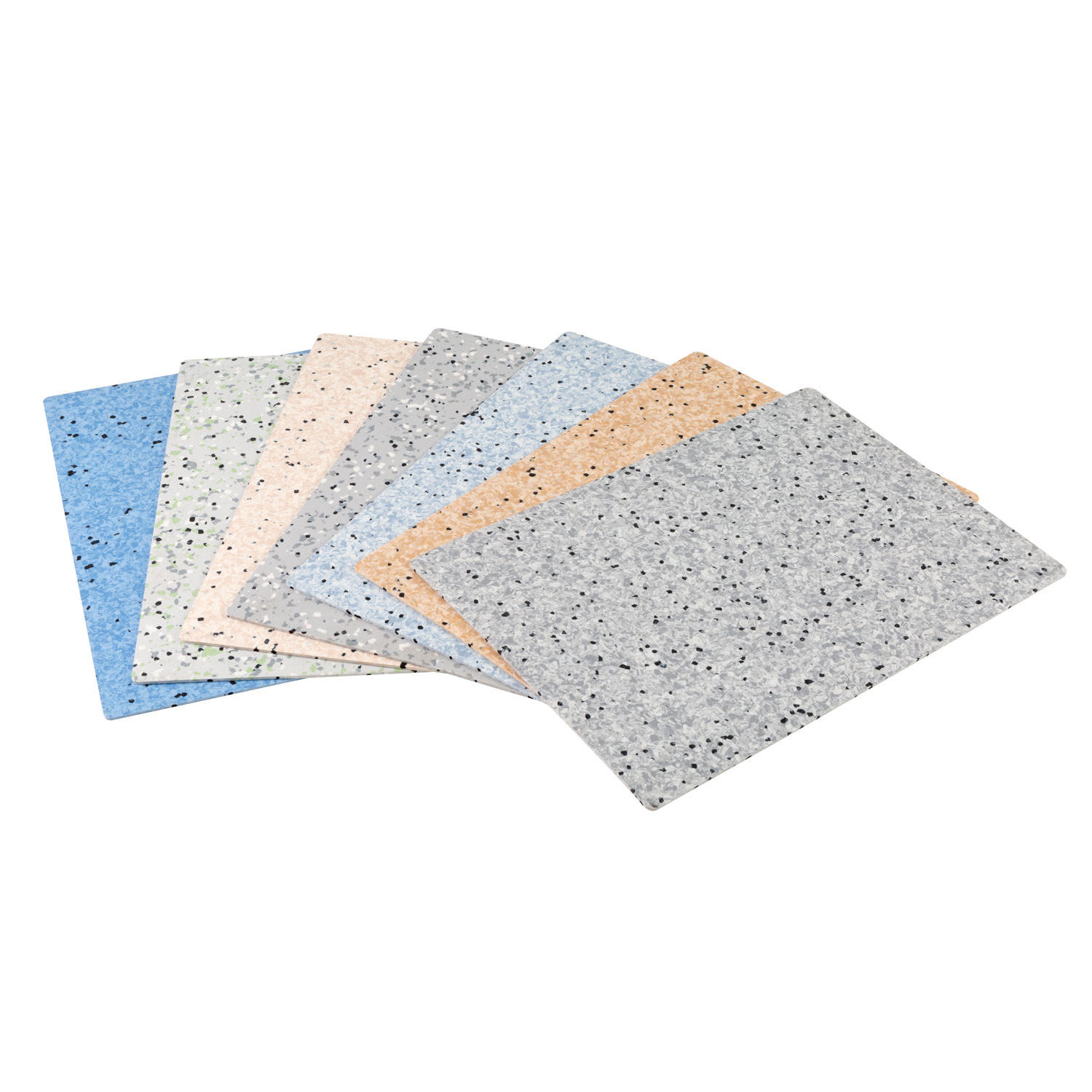
Color / zoningMultiple patterns and colors are shown in current ESD programs.Approved sample, room zoning, batch reference, replacement stock and OEM/private-label requirements.
Installation systemCommercial resilient sheet is generally installed as a bonded system.Subfloor flatness, moisture, primer/adhesive compatibility, ground points, room conditioning and handover test.

If the project needs a through-body resilient structure beyond ESD-only areas, compare the verified 3C-Floor homogeneous PVC flooring range before finalizing room-by-room material schedules.

Information Gain

Five Specification Mistakes That Common Cleanroom Flooring Pages Rarely Explain

01

Calling any smooth vinyl a “cleanroom floor”

A smooth surface can be easy to clean, but cleanroom suitability also depends on contamination behavior, seams, perimeter details, maintenance and the room's classification strategy. Flooring alone does not create a cleanroom classification.

02

Using “anti-static” without a resistance target

Anti-static is a broad marketing term. Electronics and semiconductor buyers should specify the electrical range, test method and complete grounding pathway required by the facility ESD program.

03

Ignoring the difference between roll and tile

Roll flooring can reduce joint density across clean areas, while tile can simplify local replacement. The choice affects seam count, repair strategy, layout yield and installation sequencing.

04

Approving material before the chemical list

Semiconductor and electronics facilities can expose floors to cleaners, solvents, process chemicals or flux residues. “Chemical resistant” is not universal. Send the actual chemical list and exposure conditions for review.

05

Treating a data center floor as one product decision

A data center anti-static floor may need to interface with raised access panels, cable routing, airflow, high equipment loads and facility grounding. Anti-static surface performance and access-floor architecture are separate design questions.

06

Skipping post-installation testing

An ESD material sample can pass a lab value while an installed system fails because of adhesive, grounding, contamination or workmanship. Acceptance should verify the completed system using the project's specified method.

Project Image Pack

3C-Floor Cleanroom & ESD Flooring References

All images below use real 3C-Floor website image URLs and describe the product or application shown rather than repeating keywords.

Installation Logic

Cleanroom Performance Depends on the Installed System, Not the Roll Alone

Step 01

Map the subfloor

Check flatness, cracks, moisture and contamination before specifying adhesive or conductive pathways. ESD performance cannot compensate for a poorly prepared substrate.

Step 02

Design the seam layout

Use sheet width and room geometry to reduce unnecessary joints. Where sealed seams are required, coordinate compatible vinyl floor welding rod before installation begins.

Step 03

Define the ground path

Grounding strips, points, adhesive and connection to facility earth should follow the project ESD design. Do not improvise ground spacing on site.

Step 04

Test after installation

Verify the complete floor system using the specified method after adhesive cure and before production handover. Keep the baseline results for future maintenance checks.

Semiconductor & Electronics Focus

When Cleanroom Flooring Needs More Than Static Control

Semiconductor flooring and electronics factory flooring frequently sit at the intersection of several requirements: electrostatic control, particle management, cleaning, chemical exposure, rolling equipment and contamination-sensitive processes. These factors should be reviewed together rather than assigned to separate departments after material selection.

Semiconductor wet-process or chemical-support areas

Send acids, alkalis, solvents, oxidizers, cleaners and expected contact time before approving resilient flooring. A floor that is appropriate for dry electronics assembly may not be appropriate for a wet-process chemical zone. For chemistry-led rooms, use 3C-Floor's chemical-resistant vinyl flooring specification guide as a separate approval track.

Precision electronics assembly

Static-control performance should be matched to the ESD protected area (EPA) strategy, including personnel grounding, carts, benches and handling processes. Flooring is one control element within the program—not a standalone guarantee against ESD damage.

Heavy equipment and rolling traffic

Ask about concentrated loads, wheel type, move frequency and temporary installation loads. The right thickness and construction depend on the complete load case, not only pedestrian traffic.

Standards & Verification

Use Standards to Define the Requirement—Not as Marketing Badges

Cleanroom and ESD projects may reference international or customer-specific standards. The safest procurement approach is to state which standard, edition, test method and acceptance limit the project requires, then request evidence for the exact flooring system. Do not assume a material is “compliant” because a related standard appears in a brochure.

ISO 14644-1

Purpose: classification of cleanroom air cleanliness by airborne particle concentration. Flooring selection should support the controlled environment, but the floor itself does not independently establish the cleanroom class.

IEC 61340-5-1

Purpose: general requirements for an ESD control program protecting electronic devices. Projects may use this framework to define static-control elements and verification requirements.

ANSI/ESD S20.20

Purpose: an ESD control program standard for electrical/electronic parts, assemblies and equipment. The specified facility program should determine how flooring is integrated with personnel and equipment grounding.

B2B Procurement

Build a Cleanroom Flooring RFQ That Can Be Quoted Accurately

“Please quote anti-static cleanroom flooring” is not enough for a semiconductor or electronics project. A stronger RFQ lets the supplier match construction, electrical behavior, format, installation and documents to the room rather than guessing from one keyword.

Send these items with your inquiry

Facility: semiconductor, electronics, data center, laboratory, pharma
Room function: cleanroom, assembly, test, control, corridor, server/support
Area: total m² and room dimensions
ESD target: conductive / dissipative range and test method
Cleanroom: required classification / owner specification
Format: sheet or tile, thickness, roll size preference
Subfloor: concrete, raised access interface, moisture condition
Seams: welding, coving, wall-floor transition requirements
Chemicals: reagent names, concentration and contact time
Traffic: people, carts, AGV, equipment moves, wheel loads
Visual: color zoning, approved sample, replacement stock
Commercial: quantity, packaging/private label, destination port

Why 3C-Floor

A Practical Supply Partner for Multi-Room Flooring Programs

ESD + homogeneous product coverage

3C-Floor currently publishes anti-static vinyl roll, conductive flooring, homogeneous PVC sheet and related commercial flooring programs, allowing controlled areas and adjacent non-ESD spaces to be planned within one broader flooring sourcing program.

Specification-first project discussion

Instead of approving from color alone, buyers can define thickness, roll/tile format, static-control direction, room use, chemical exposure, seams, color zoning and supporting documentation before final product approval.

OEM and repeat-order coordination

For distributors, contractors and private-label programs, project colors, packaging and repeat-order specification control can be coordinated by program. Final custom scope depends on the selected construction and order requirements.

Related Questions

Cleanroom Flooring FAQ

What flooring is best for a cleanroom?

The best cleanroom flooring is the system that matches the room's particle-control, ESD, chemical, traffic, seam and cleaning requirements. For many electronics and controlled interiors, homogeneous ESD vinyl sheet is a practical option because it combines a cleanable resilient surface with static-control constructions and low-joint roll installation. Final suitability must be confirmed against the facility specification.

What is the difference between conductive and static-dissipative cleanroom flooring?

Conductive and static-dissipative flooring are two different electrical resistance ranges used in ESD control. Current 3C-Floor product pages list conductive flooring below 1.0 × 10⁶ ohms and static-dissipative flooring from 1.0 × 10⁶ to 1.0 × 10⁹ ohms. The project ESD program and test method should determine which range is required.

Is anti-static vinyl flooring suitable for semiconductor manufacturing?

It can be suitable for semiconductor and microelectronics areas when the exact product, grounding system, seams, contamination requirements, chemicals and electrical resistance criteria are approved together. Semiconductor fabs should not select flooring from an anti-static label alone.

Can cleanroom vinyl sheet flooring be heat welded? ,

Compatible PVC sheet flooring can use heat-welded seams with matching vinyl welding rod. This reduces open joint lines and can improve cleanability, but the seam design, adhesive, coving and perimeter details must be part of the full installation specification.

Is data center anti-static flooring the same as raised access flooring?

No. Anti-static flooring describes static-control performance, while raised access flooring describes a structural access-floor system. Some data center areas may require both functions, while control rooms or technical support areas may use anti-static vinyl without a raised floor depending on the facility design.

What thickness is available for 3C-Floor ESD vinyl flooring?

3C-Floor's current ESD and anti-static pages list common thicknesses including 2.0 mm, 2.5 mm and 3.0 mm depending on the selected roll or tile construction. Buyers should confirm the exact SKU, roll size, resistance range and technical data before project approval.

What information should I send for a cleanroom flooring quotation?

Send the facility type, room function, total area, required electrical resistance range, cleanroom requirement, thickness and format, seam and coving plan, subfloor condition, chemical exposure, traffic and rolling loads, color zoning, required standards or reports, quantity, packaging needs and destination port.

Send the Room Schedule—Not Just the Keyword “Cleanroom Flooring”

3C-Floor can review your semiconductor flooring, electronics factory flooring or data center anti-static floor requirement more effectively when the inquiry includes room function, electrical resistance target, cleanroom requirement, floor area, thickness/format, chemical exposure, traffic, subfloor, seam details, color, documentation needs and destination port.

Request a Cleanroom Flooring Quote
Landlord hotline:
+86-021-54361792
Email:
info@3c-floor.com