- 0086 13321818576 (Steven Lee)
- info@3c-floor.com
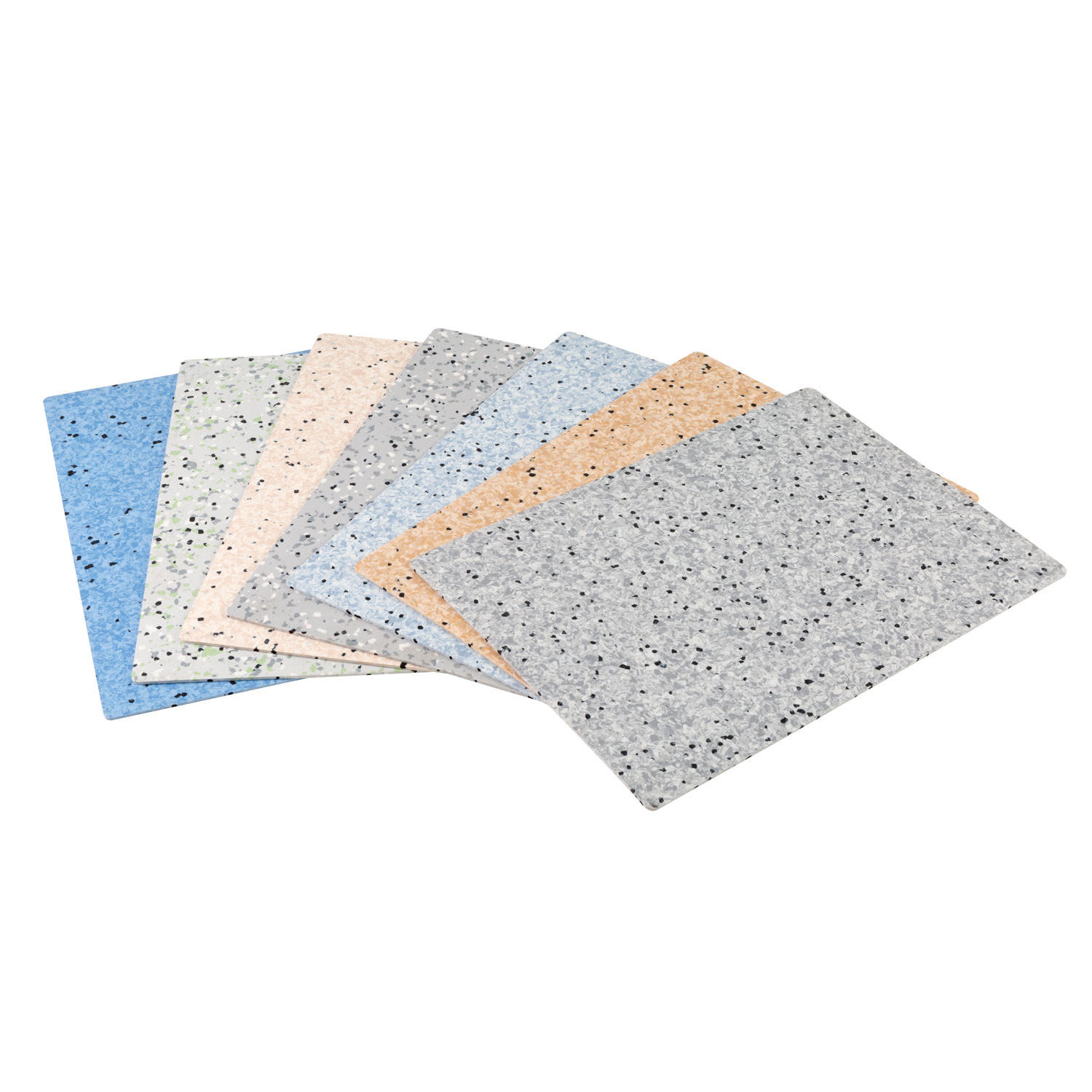
3C-Floor supplies anti-static PVC flooring solutions built for projects where electrostatic control, wear resistance, cleanability, and supply consistency all matter. Whether you need static dissipative vinyl flooring, conductive vinyl flooring, OEM branding, project customization, or factory-direct export support, our team helps distributors, contractors, and industrial buyers source the right specification for the right environment.
Tell us your application, target resistance range, thickness, installation preference, project quantity, and destination market. We can recommend a suitable ESD vinyl flooring solution and prepare a fast quotation with OEM/custom options.
ESD vinyl flooring is a resilient PVC floor system designed to control electrostatic discharge by managing how electrical charges move across the surface and into the grounding system. In practical terms, this means the floor is not just a decorative finish. It becomes part of a larger ESD control strategy for areas where static electricity can damage components, disrupt sensitive equipment, attract contamination, or reduce process stability.
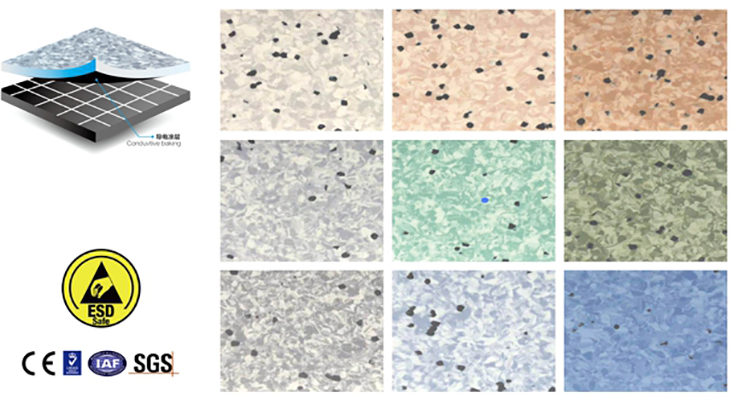
Compared with ordinary commercial vinyl floors, anti-static vinyl flooring uses engineered conductive or static-dissipative structures so electrostatic charges do not accumulate randomly. This is especially important in electronics assembly, precision manufacturing, server infrastructure, laboratories, pharmaceutical technical zones, and other controlled environments where flooring performance must support both daily traffic and technical reliability.
As a professional supplier, 3C-Floor supports buyers looking for ESD PVC sheet flooring, antistatic PVC roll flooring, and project-ready options that balance electrostatic control, durability, installation efficiency, and long-term maintenance cost.
Used when controlled discharge is required without overly rapid charge transfer. Often selected for many electronics, technical, and laboratory spaces.
Selected for more demanding electrostatic control environments where faster charge transfer is part of the project requirement.
Different formats support different installation plans, seam control, replacement preferences, and lifecycle maintenance strategies.
The floor structure is designed to help manage static build-up in environments where process stability matters. This supports facilities handling sensitive electronics, precision instruments, and technical equipment.
ESD floors in industrial and technical environments must handle foot traffic, carts, routine cleaning, and operational movement. A robust wear layer helps preserve appearance and service life.
Smooth, resilient surfaces are easier to maintain than many other technical flooring systems. For clean-oriented spaces, fewer joints and controlled seams are often a major benefit.
Buyers can choose ESD vinyl tile, ESD vinyl sheet, or PVC roll solutions based on room layout, installation method, replacement strategy, and hygiene requirements.
We support private label, customized packaging, project-matched thickness, and format selection to help distributors, contractors, and brand customers build a stronger offer in their own markets.
When the supplier understands product structure, production flow, packaging, and export handling, communication becomes faster and technical requests are easier to control.
We support project matching for distributors, importers, contractors, and private-label customers who need custom thickness, special packaging, roll length planning, or market-specific product presentation.
The table below shows typical supply ranges for commercial discussion and project matching. Final data should be confirmed against the exact product structure, application requirement, installation method, and destination market.
| Item | Typical Options | Why It Matters |
|---|---|---|
| Total Thickness | 2.0 mm / 2.5 mm / 3.0 mm | Helps balance wear resistance, underfoot feel, and project budget. |
| Formats | Tile / Sheet / Roll | Different layouts and maintenance plans may favor different formats. |
| Roll Width | 2.0 m | Useful for larger-area installation with fewer seams. |
| Roll Length | 20 m – 25 m | Supports project planning and installation efficiency. |
| Performance Grade | Static Dissipative / Conductive | Selected according to the target control level of the environment. |
| Surface / System Resistance | Project-based target range according to product grade and test plan | Resistance values must be reviewed together with installation and grounding details. |
| Installation | Glue-down with conductive adhesive + copper tape + grounding design | Correct installation is essential for reliable ESD performance. |
| Customization | Color, thickness, size, label, package, OEM branding | Supports distributors, tenders, and project-specific requests. |
PVC base with anti-static / conductive design for electrostatic control applications.
Support for technical discussion, sample confirmation, and test-report coordination according to order scope.
Helpful for repeat orders, distributor stock planning, and multi-area project scheduling.
Electrostatic control is not limited to one industry. As equipment becomes more precise and digital systems become more sensitive, more projects require flooring that supports stable technical operation as well as everyday durability.
PCB assembly, component handling, precision assembly lines, and testing areas where electrostatic discharge can affect product quality or yield.
Spaces that need controlled surfaces, easier hygiene management, and compatibility with technical operating procedures.
Technical support zones, control rooms, and infrastructure spaces where electrostatic stability and maintenance efficiency are important.
Some laboratories, equipment-support spaces, and operating-adjacent zones require resilient floors with easier maintenance and controlled performance.
Control rooms, equipment rooms, and communication infrastructure spaces where reliable technical flooring is preferred.
Battery-related support zones, instrumentation rooms, and process areas that need consistent floor performance under repeated use.
If you are still comparing formats, you can also review ESD vinyl tiles vs sheets and learn how ESD flooring works before choosing the most suitable structure for your project.
Send us your room type, floor format preference, estimated quantity, and target market. We can help narrow down the right static dissipative or conductive solution more efficiently.
You are not just buying a catalog item. You are working with a supplier that understands production feasibility, product structure, export packaging, and technical communication.
We support customers who need a stronger own-brand offer, cleaner packaging presentation, and repeatable specification management.
For ESD floors, consistency matters. Product matching, production control, installation logic, and testing communication all influence final project results.
Commercial flooring projects often run on tight schedules. A responsive supplier helps reduce delays in sample approval, production planning, and shipment coordination.
We can assist with sample requests, product discussions, OEM packaging planning, and supply communication for distributors and contractors.
If your project includes standard commercial areas in addition to technical zones, we can also support matching with homogeneous PVC flooring and wider vinyl flooring manufacturer solutions.
| Buyer Concern | What 3C-Floor Focuses On | Commercial Value |
|---|---|---|
| Stable ESD Performance | Consistent product structure and technical communication | Helps reduce mismatch risk between application and specification |
| OEM / Custom Need | Flexible support for packaging, private label, and project matching | Useful for brands, importers, and distributors |
| Delivery Reliability | Production planning and export coordination | Supports tender timing and project execution |
| Quality Assurance | Routine inspection and document coordination | Stronger confidence during procurement review |
| Option | Main Advantage | Possible Limitation | Recommended Use |
|---|---|---|---|
| ESD Vinyl Flooring | Balanced electrostatic control, resilient feel, easier maintenance, multiple formats | Requires correct installation and grounding details | Electronics plants, labs, cleanrooms, data centers, technical rooms |
| Standard Commercial Vinyl | Lower initial cost for general-use spaces | No dedicated ESD-control function | Offices, retail, non-technical common areas |
| Anti-Static Epoxy Coating | Seamless visual appearance and hard surface | Different feel underfoot; maintenance and repair considerations vary by site | Some industrial and utility zones |
| Raised Access Flooring System | Useful where underfloor cabling and access are primary requirements | System complexity and cost can be higher | Selected control rooms, data facilities, and specialized infrastructure layouts |
Best for many controlled environments where safe, controlled charge dissipation is needed without jumping directly to more aggressive conductive performance.
Better for applications with stricter electrostatic control plans, depending on the process risk, equipment sensitivity, and full project design.
The example below is a typical project scenario used to show how buyers evaluate ESD vinyl flooring in real procurement discussions.
An electronics assembly customer needed a resilient floor for an upgraded production zone, inspection pathway, and component handling area. The project required easier cleaning than many hard technical surfaces, a controlled static environment, and a supply plan that matched phased installation.
The buyer focused on consistent product specification, practical installation support, stable lead time, sample confirmation, and export packaging suitable for cross-border delivery.
A project-matched ESD vinyl flooring solution with confirmed thickness, installation guidance, grounding details, and order packaging plan helped simplify procurement communication and on-site execution.
By aligning product format, electrostatic target, and installation method early, the customer reduced rework risk, improved purchasing clarity, and moved faster from sample review to order planning.
Whether you are sourcing for distribution, a contractor package, or a direct industrial project, we can support quote preparation, sample confirmation, and product matching.
ESD vinyl flooring is a PVC-based resilient floor designed to control electrostatic discharge in environments where sensitive components, instruments, or technical operations require a more stable electrostatic condition.
“Anti-static” is often used as a broad commercial term. In technical selection, the more useful distinction is between static dissipative flooring and conductive flooring. Static dissipative grades release charge in a controlled way, while conductive grades transfer charge faster. The right choice depends on the project control requirement.
Yes. Product performance depends on proper installation, including conductive adhesive, copper tape, and grounding details where required. Flooring alone is not enough if the installation system is incomplete.
ESD vinyl sheet is often preferred when fewer seams and easier hygiene management are priorities. ESD vinyl tile may be useful where modular replacement or certain room layouts are preferred. The choice depends on traffic, maintenance plan, and installation strategy.
Yes. We support OEM / custom requests such as branding, packaging, thickness options, color matching, and project-based product coordination for distributors, contractors, and importers.
The most helpful information includes application area, preferred format, target thickness, estimated quantity, destination country, required documentation, and whether you need OEM / private label support.
Yes. These are among the most common application areas because they require controlled electrostatic behavior, practical maintenance, and reliable day-to-day durability.
Maintenance should follow the product and installation guidance for the selected system. In technical spaces, cleaning agents, maintenance routines, and verification practices should be chosen to support long-term functional performance as well as appearance.