Corridors & main circulation
Prioritize durability, predictable cleaning, rolling-load performance, seam quality and color zoning. Homogeneous sheet is often a practical first option for intensive use.



Hospital PVC flooring is resilient vinyl sheet selected for healthcare spaces that need cleanable surfaces, controlled seams, durable traffic performance and room-specific safety. 3C-Floor supplies homogeneous and heterogeneous PVC flooring roll programs for hospitals, clinics, medical centers and healthcare contractors, with specification support for thickness, roll format, color, welding accessories, OEM packaging and project documentation.

For most hospital corridors, wards and treatment spaces, start by evaluating commercial homogeneous or heterogeneous PVC vinyl sheet rather than plank flooring. Prioritize a smooth cleanable surface, full-spread bonding, heat-welded seams where the project requires them, compatible coving, resistance to the facility's actual cleaning chemicals, and a construction matched to rolling beds and carts. Use specialty ESD, wet-area or chemical-resistant flooring only in rooms that require those functions.
The procurement question is not simply “Which hospital vinyl floor is antibacterial?” A more reliable specification connects room function, traffic, cleaning chemistry, seams, subfloor, slip needs and specialty requirements before product approval.
Healthcare buildings contain several different risk profiles. The following matrix is a procurement starting point; project drawings, local standards and the facility's infection-control and safety requirements remain the final authority.
Prioritize durability, predictable cleaning, rolling-load performance, seam quality and color zoning. Homogeneous sheet is often a practical first option for intensive use.
Balance cleanability, quiet movement, comfort underfoot, easy bed movement and a calmer visual palette. Review acoustic construction if impact sound is a project priority.
Focus on a smooth non-porous surface, stain risk, disinfectant compatibility, welded joint detailing and cleanable wall-floor transitions.
Do not assume generic medical vinyl is sufficient. Static-control, conductivity, cleanroom, chemical or other technical requirements may apply to the exact room.
List routine reagents, stains and disinfectants before product approval. Chemical resistance and ESD needs should be verified against the exact product data.
Slip requirements may be more demanding than dry corridors. Use a safety-flooring specification where the project calls for sustained wet slip resistance.
For a broader room-function overview, compare 3C-Floor's hospital flooring solutions before locking the room schedule.
Homogeneous PVC flooring carries a consistent material structure through the body, making it a strong starting point for high-use healthcare interiors where long-term wear and repair logic matter. 3C-Floor's current homogeneous PVC flooring program shows common sheet formats around 2 m wide and healthcare applications such as hospitals, laboratories and pharmaceutical areas.
Heterogeneous vinyl sheet uses multiple functional layers and a dedicated design/wear surface. This can provide greater visual flexibility for patient areas, waiting zones, senior care and design-led clinical interiors. 3C-Floor's heterogeneous vinyl rolls page lists 2 m × 20 m roll formats, 2.0–3.0 mm overall thickness and wear-layer options within its commercial program.
Neither construction should be selected from thickness alone. Ask how the floor will be cleaned, what rolls across it, how seams will be detailed, what slip target applies and whether the room needs static-control or special chemical resistance.

Use this table as an RFQ framework. Values shown as program references come from current 3C-Floor PVC roll pages and should be reconfirmed for the exact color, construction and order.
| Specification item | Homogeneous healthcare sheet | Heterogeneous healthcare sheet | Buyer decision |
|---|---|---|---|
| Product structure | Consistent through-body vinyl construction | Multi-layer vinyl with design and wear surface | Choose by traffic, repair logic, visual requirements and maintenance plan. |
| Overall thickness | Current 3C-Floor program references include about 2.0–3.0 mm options | Current 3C-Floor program references include 2.0–3.0 mm | Do not use thickness as the only indicator of durability. |
| Typical width | 2 m program reference | 2 m program reference | Confirm roll length, room layout, seam plan and waste factor. |
| Wear concept | Wear is carried through the body | Dedicated wear layer; 3C-Floor lists 0.12–0.7 mm across the roll program | Match the exact wear construction to traffic and maintenance needs. |
| Surface treatment | Program-dependent maintenance treatment | UV-treated commercial surface on relevant products | Request exact stain, chemical and maintenance information. |
| Installation | Full-spread glue-down; heat-weld seams where specified | Full-spread glue-down; heat-weld seams where specified | Confirm substrate, adhesive, welding rod, cove and transition details. |
| Antibacterial / antimicrobial claim | Available on selected program; verify exact report | Available on selected program; verify exact report | Require the test method and report for the exact product being purchased. |
| Color & zoning | Project color coordination | Broader printed visual possibilities | Approve physical samples and record color references for repeat orders. |
| Packaging / OEM | Confirm by project and order program | Confirm by project and order program | Align carton/label language, roll marks, color codes and private-label needs before mass production. |
Browse the broader PVC flooring roll material program when comparing commercial sheet constructions beyond healthcare use.
A cleanable sheet surface can still underperform if the substrate is damp or uneven, adhesive is incompatible, joints are poorly grooved, welds are weak or perimeter details leave hard-to-clean edges. Treat installation items as procurement items.
Confirm flatness, dryness, strength and surface preparation before adhesive application. Sheet flooring can telegraph substrate defects.
Match adhesive to substrate, vinyl construction and jobsite conditions. Correct open time and rolling help prevent bubbles and weak bond zones.
Where specified, use a compatible vinyl floor welding rod and control groove geometry, temperature, speed and trimming.
Coved edges and transitions should be designed for the facility's cleaning protocol and room interfaces rather than improvised on site.
These errors often occur before installation. Correcting them in the RFQ and sample-approval stage can improve project consistency and reduce change orders.
That phrase does not define construction, seams, traffic, chemicals, slip behavior or test evidence. Specify the floor system and required reports.
A dry corridor, wet shower area and diagnostic room can have different risks. Split the project by room function before optimizing price.
Thickness does not explain through-body vs. wear-layer construction, surface treatment, rolling-load behavior or maintenance needs.
Hospitals may use strong disinfectants and staining agents. Ask the facility what is used routinely and verify compatibility against the selected product data.
Record color codes, approved samples, surface finish and construction details. Repeat orders should reference the same approved specification, not only a photograph.
Operating, imaging, laboratory and electronics-sensitive rooms may need static-control performance. Review 3C-Floor's resilient anti-static flooring as a separate specialty path rather than assuming standard hospital vinyl is suitable.

Antibacterial or antimicrobial vinyl may be useful in healthcare, but procurement should connect the claim to the exact SKU, test method and report. A generic website statement should not be treated as a substitute for product-specific evidence.
More importantly, antimicrobial performance does not replace routine cleaning, disinfection, hand hygiene or facility infection-control protocols. Hospital PVC flooring should be selected as part of a cleanable system: smooth surface, controlled seams, compatible perimeter details and a maintenance procedure that matches the actual flooring construction.
For projects where an antibacterial surface is a primary selection criterion, review 3C-Floor's dedicated antibacterial vinyl flooring for hospitals page alongside this broader hospital PVC procurement guide.
The images below are hosted on 3C-Floor and can be reused across the hero, room-application, color-selection and construction sections of this page. The ALT text is descriptive rather than keyword-stuffed.


Hero filename: hospital-pvc-flooring-corridor.jpg · ALT: Hospital corridor with color-zoned PVC vinyl sheet flooring
Application filename: healthcare-vinyl-flooring-reception.jpg · ALT: Hospital reception and waiting corridor with smooth vinyl flooring
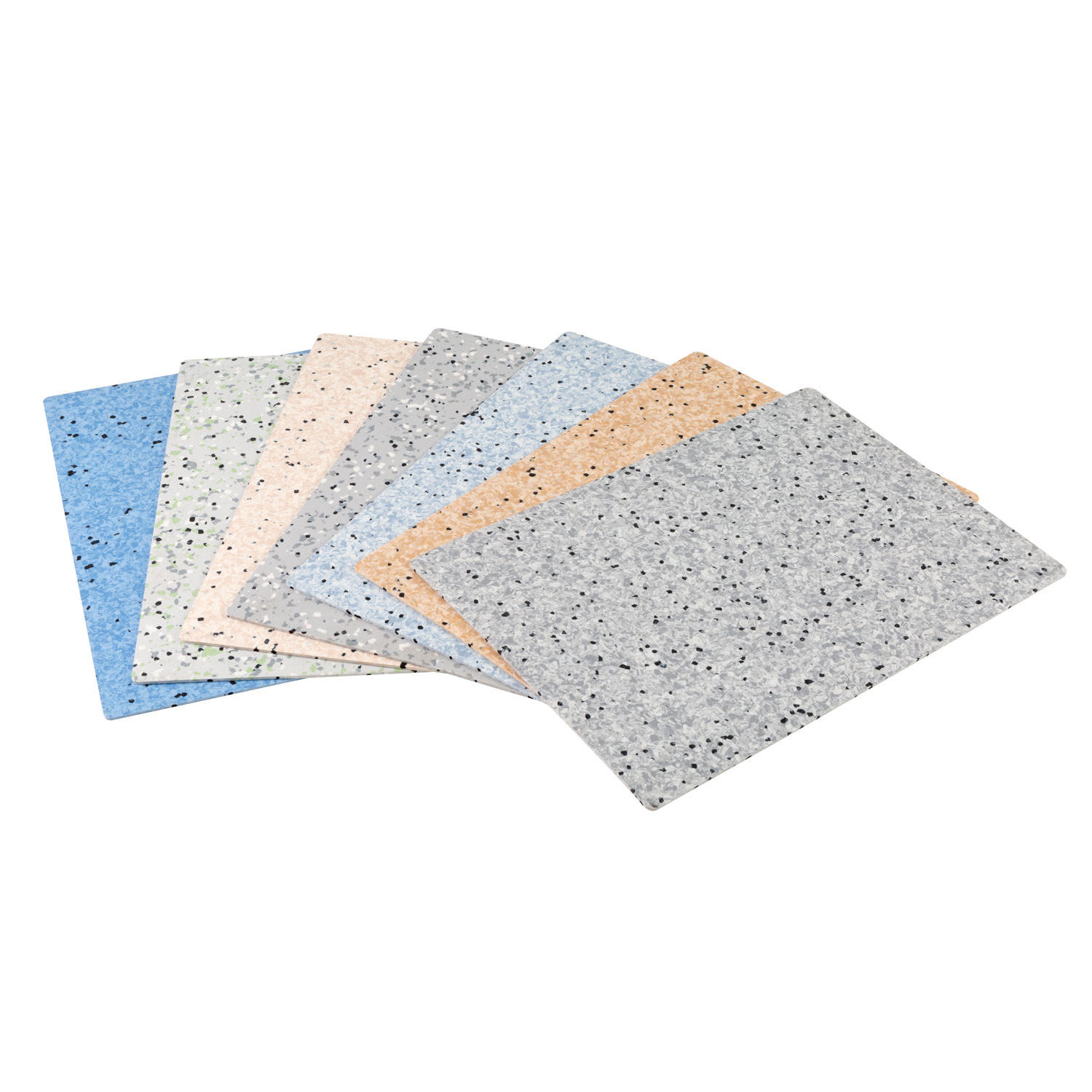
Color filename: homogeneous-hospital-vinyl-color-samples.jpg · ALT: Homogeneous PVC flooring sample colors for healthcare projects
Structure filename: heterogeneous-vinyl-sheet-layer-structure.png · ALT: Multi-layer vinyl sheet flooring construction with wear layer and backing
A clear RFQ allows the supplier to screen out unsuitable structures before sampling. Include the room schedule when different hospital areas have different performance needs.
These answer units are written for project buyers, architects, contractors and sourcing teams comparing medical vinyl flooring options.
Homogeneous vinyl sheet is a common starting point for heavily used clinical corridors, wards and treatment areas. Its construction is consistent through the thickness, and sheet installation can be heat welded. Heterogeneous vinyl sheet may be preferred where design, comfort or a dedicated wear layer is more important. Wet-area, ESD or chemical-resistant rooms should be specified separately.
3C-Floor's current commercial vinyl roll pages show common overall thickness options around 2.0–3.0 mm, depending on construction. The correct thickness should be selected together with traffic, rolling loads, surface construction, substrate conditions and room requirements. A thicker floor is not automatically the better hospital floor.
Heat-welded seams reduce open joints and help create a more cleanable continuous finish. The result depends on correct substrate preparation, full-spread adhesive, grooving, compatible welding rod, welding temperature, trimming and perimeter detailing. A visually closed joint is not enough if the underlying bond is poor.
No. Antibacterial or antimicrobial performance is an additional material characteristic; it does not replace cleaning, disinfection or infection-control procedures. Ask for the exact test method and report for the selected SKU, then design seams and coving to support the facility's cleaning practice.
Possibly, but a general hospital vinyl specification should not automatically be used in an operating room. Operating, imaging and technical rooms may require static-control, electrical, chemical, cleanroom, slip or other specialty performance. The room specification and local requirements must take priority.
Compare them by wear concept, design needs, cleaning plan, traffic, rolling loads and repair expectations—not by price or thickness alone. Homogeneous sheet favors through-body wear and heavy-use logic. Heterogeneous sheet offers more design flexibility and a dedicated wear surface.
Send room names, area, construction preference, thickness, roll dimensions, traffic and rolling loads, cleaning chemicals, colors, seam/coving requirements, test standards, packaging needs and destination port. The room schedule is especially useful because it prevents over-specifying low-risk rooms and under-specifying technical areas.
3C-Floor supports B2B project and customization discussions for PVC flooring roll programs. Product specification, color direction, packaging and related project requirements can be coordinated for suitable programs; final OEM scope and documentation should be confirmed against the selected construction and order.
These verified pages support the hospital PVC flooring buying process without duplicating this page's core procurement intent.
Send 3C-Floor the room types, area, homogeneous/heterogeneous preference, thickness, roll format, traffic and rolling loads, cleaning chemicals, color plan, welding/coving requirements, test standards, packaging needs and destination port. A complete RFQ makes product comparison faster and more reliable.