Welcome to 3C-Floor — Your Trusted Manufacturer of SPC Flooring, WPC Vinyl Flooring, LVT Flooring & PVC Flooring Rolls.
  • 0086 13321818576 (Steven Lee)
News
Current Location:Home > News

LVT Wear Layer Guide | 0.2mm, 0.3mm, 0.5mm & 0.7mm LVT | 3C-Floor

Update:2026/8/25 9:29:17 Views:0
3C-Floor flooring manufacturer logo
LVT · SPC · WPC · PVC Flooring Manufacturing & Export Supply
Request A Quote
LVT Specification Guide & Factory Supply

LVT Wear Layer: Choose 0.2mm, 0.3mm, 0.5mm or 0.7mm for the Traffic You Actually Have

The wear layer is a small number with a large effect on LVT positioning. 3C-Floor helps distributors, contractors, developers and private-label buyers match 0.2mm LVT, 0.3mm LVT, 0.5mm commercial LVT and 0.7mm wear layer LVT to traffic, installation method, lifecycle target and budget—before a sample becomes a bulk order.

0.2mm≈ 8 mil
0.3mm≈ 12 mil
0.5mm≈ 20 mil
0.7mm≈ 28 mil
3C-Floor LVT flooring plank showing durable wood-look surface and layered construction
3C-Floor LVT product image · wear layer, décor, body construction and installation system should be specified together.
Direct answer

What LVT wear layer should you choose?

For a fast purchasing decision: 0.2mm is generally positioned for value-oriented, lower-traffic residential use; 0.3mm is a common mainstream residential specification and can extend into selected light-commercial programs; 0.5mm is a practical commercial starting point for many offices, retail and hospitality projects; and 0.7mm is commonly chosen where traffic, rolling loads, cleaning frequency or lifecycle expectations are more demanding.

That is a starting framework—not a substitute for the exact product classification. The final choice should also consider the surface treatment, total construction, installation system, subfloor, castor or trolley movement, cleaning program and the tested use class of the selected SKU.

0.2mm vs 0.3mm vs 0.5mm vs 0.7mm

Four wear-layer tiers, four different sourcing strategies

A thicker wear layer normally increases the reserve of transparent protective material above the printed décor. But buying only by the largest number can over-specify a residential line, increase cost and reduce price competitiveness. The goal is to buy enough performance for the application—with evidence that the complete product supports the claim.

0.2mm
about 8 mil
Value Residential

For controlled, lower-traffic rooms

Useful when first cost is important and the floor is intended for bedrooms, guest rooms, light-use apartments or other controlled residential environments.

Buyer focus: avoid marketing it as a heavy-duty specification unless the exact SKU has test evidence supporting that claim.

0.3mm
about 12 mil
Mainstream Residential

Balanced price and everyday durability

A widely used step-up for living areas, apartment programs, rental renovation and retail collections where buyers want a credible everyday specification without moving immediately to commercial cost.

Buyer focus: check surface treatment and use classification if the SKU will enter public or commercial spaces.

0.5mm
about 20 mil
Commercial Starting Point

For offices, retail and hospitality

Often selected for higher-traffic interiors because it gives more wear reserve than 0.2–0.3mm products while still allowing competitive commercial positioning.

Buyer focus: chair casters, trolley routes, entrance soil and cleaning frequency can matter as much as pedestrian count.

0.7mm
about 28 mil
Demanding Commercial

For higher traffic and lifecycle targets

Consider when busy corridors, store circulation, hospitality operations or repeat cleaning cycles justify additional wear-layer reserve.

Buyer focus: confirm that the full flooring construction—not only the clear layer—matches the required commercial use class and local specification.

Layer function

Wear layer is not the same as total LVT thickness

This distinction prevents one of the most common flooring sourcing mistakes. Total thickness describes the complete plank or tile. It can influence installation profile, handling, click-system geometry, comfort and the overall build-up of the floor. Wear layer thickness describes the transparent protective film above the décor. Its job is to take surface wear before traffic reaches the printed design.

A 5mm click product with a thin wear layer is not automatically more durable at the surface than a 2.5mm glue-down product with a stronger commercial wear layer. Conversely, a thick wear layer cannot compensate for an unsuitable installation system, poor subfloor preparation or a product that does not meet the required project tests.

Important unit check: “mil” and “mm” are different. One mil is 0.001 inch. Approximate conversions are 0.2mm ≈ 8 mil, 0.3mm ≈ 12 mil, 0.5mm ≈ 20 mil and 0.7mm ≈ 28 mil.
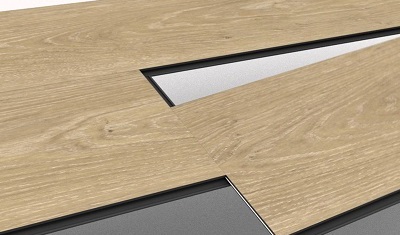
LVT flooring structure diagram showing transparent wear resistant layer, decorative layer and core layers
Layered vinyl construction shown on a 3C-Floor site image. Final constructions differ by LVT format and SKU.
Buyer matrix

Match the wear layer to the way the space operates

“Residential” and “commercial” are useful labels, but project buyers get better results by describing the actual workload: people, wheels, dirt, cleaning, furniture movement and expected replacement cycle.

Use scenario Common starting point Why buyers choose it What should be checked before approval
Bedrooms, guest rooms, light-use residential 0.2mm LVT Keeps material cost controlled for spaces with limited daily abrasion. Warranty wording, household type, pets, cleaning habits and the exact surface finish.
Apartments, living rooms, rentals, residential retail lines 0.3mm LVT Balanced specification for broader household use and mainstream market positioning. Entry traffic, furniture movement, installation method and target use classification.
Offices, boutiques, hotel guestrooms, moderate retail 0.5mm commercial LVT More wear reserve for repeated traffic while maintaining efficient LVT construction. Chair casters, luggage, trolleys, cleaning chemistry, fire/slip/VOC requirements.
Busy retail, hotel corridors, high-use offices, demanding public interiors 0.7mm wear layer LVT Additional protective material for projects where appearance retention and service interval matter. Tested class, rolling load, entrance mat strategy, maintenance equipment and replacement plan.
Chain stores and multi-site programs Often 0.5–0.7mm Standardizes one commercial platform across multiple locations. Repeat-color control, carton/SKU coding, phased delivery, maintenance stock and re-order matching.

Typical starting points are procurement guidance only. Commercial classification must be verified on the exact product construction and applicable test documents.

Specification logic

A thicker wear layer helps—but it does not solve every flooring problem

The strongest product page should help buyers avoid false equivalence. Wear layer is one variable within a system.

Surface treatment matters

UV or PU treatments can influence scuff visibility, stain response and maintenance. Two 0.5mm products can perform differently if the top-surface chemistry and finishing quality are different.

Indentation is a different property

A thicker wear layer mainly adds surface-wear reserve. Heavy point loads, furniture feet and rolling equipment also depend on the body construction and the flooring system’s indentation performance.

Installation changes the risk profile

Commercial glue-down LVT, click LVT and loose lay LVT respond differently to subfloor flatness, movement, rolling loads, downtime and future plank replacement.

Traffic is not only footsteps

Office chairs, housekeeping carts, shopping trolleys, luggage wheels and frequent furniture changes can be more aggressive than simple pedestrian traffic.

Entrance conditions accelerate wear

Grit and fine sand carried through entrances can act as abrasives. Good matting, cleaning routines and correct floor-care procedures protect even a heavier wear-layer specification.

Use class beats guesswork

For specification projects, ask for the test data or classification tied to the exact product. Do not assume that a single wear-layer number automatically guarantees every commercial use claim.

Installation choice

Use the wear layer together with the LVT installation format

Floating

Click LVT

Suitable when renovation speed and floating installation are priorities. Wear-layer options can cover mainstream residential through commercial programs, but the click profile, flatness tolerance and rolling-load conditions must be considered.

Bonded

Dry Back LVT

Common in project work where a low profile and stable full-spread adhesive installation are important. It can be an efficient route for 0.5mm commercial LVT because material build-up stays relatively low.

Fast Change

Loose Lay LVT

Useful for selected office, retail and renovation environments where fast replacement or access considerations matter. Backing design, floor flatness and project size should be checked carefully.

B2B sourcing

How 3C-Floor turns a wear-layer request into an order-ready LVT specification

For importers and project buyers, “0.5mm LVT” is not yet a complete purchase description. 3C-Floor’s role is to connect the wear-layer target to the rest of the construction and supply workflow so the approved sample can be repeated in production.

  1. Define the use: room type, daily traffic, rolling loads, cleaning, target service life and installation window.
  2. Select the LVT format: click, dry back or loose lay according to the site and sales channel.
  3. Set the construction: wear layer, overall thickness, surface texture, size, edge, backing and décor reference.
  4. Confirm project evidence: list any required fire, slip, VOC/emission, acoustic or other technical documents before sampling.
  5. Approve the commercial details: quantity, cartons, private label, barcode, pallet marks, destination and repeat-order identification.

This approach is particularly useful for flooring distributors building a tiered catalog: an entry 0.2mm line, a mainstream 0.3mm residential line, a 0.5mm commercial line and a 0.7mm project line can share coordinated décor directions while serving different price and traffic segments.

20+ yrsPublished manufacturing & export experience
30,000㎡+Published factory scale
32-stepPublished quality-control process
3 formatsClick · Dry Back · Loose Lay LVT

OEM / private-label options

  • 0.2 / 0.3 / 0.5 / 0.7mm wear-layer programs
  • Wood, stone, neutral commercial and custom décor directions
  • Matte, embossed, wood-grain and registered-texture options by product
  • Custom plank/tile dimensions by program
  • Neutral or private-label cartons, labels and pallet marks
  • Sample approval and export shipment coordination
Cost control

Do not overbuy wear layer—and do not underbuy lifecycle

The best specification is not the thickest one. It is the lowest-risk construction that still meets traffic, maintenance and lifecycle expectations.

When a lighter wear layer can make commercial sense

A 0.2mm or 0.3mm product can be commercially sensible in a residential channel, developer apartment package or lower-traffic renovation where the buyer is managing cost per unit and the use conditions are controlled. The mistake is not choosing a thin layer—the mistake is selling it into a workload it was never specified to handle.

When a heavier wear layer earns its cost

A 0.5mm or 0.7mm product can reduce lifecycle risk when the floor faces continuous public traffic, rolling equipment, repeat cleaning or higher expectations for appearance retention. For chain programs, the value can also come from standardizing one durable specification across many sites.

Commercial procurement

What to put on an LVT RFQ besides “0.5mm wear layer”

Application

Residential, apartment, retail, office, hotel, corridor, public area or other defined use.

Installation

Click, dry back or loose lay; include subfloor type and renovation constraints.

Construction

Total thickness, wear layer, size, surface, edge, backing and target décor.

Compliance

Required test reports, use class, fire, slip, emissions or tender documentation.

Volume

Trial quantity, project area, number of colors, phased orders and expected repeat demand.

Branding

Neutral pack, OEM carton, barcode, label, pallet mark and sample-board requirements.

Logistics

Destination port/city, required delivery window and any container-loading priorities.

Approval

Lock the approved sample, product code and specification before mass production.

FAQ

Frequently asked questions about LVT wear layer thickness

What is the wear layer on LVT flooring?

The LVT wear layer is the transparent protective film positioned above the decorative print. It absorbs most normal surface abrasion, scuffing and day-to-day traffic before wear can affect the printed design. The top coating and the complete construction also contribute to real-world performance.

Is 0.2mm LVT too thin?

Not necessarily. 0.2mm LVT can be appropriate for light-use residential programs where cost efficiency is important. It becomes a poor choice when it is used in a traffic environment that requires a higher tested classification or a longer commercial lifecycle.

Is 0.3mm LVT good for apartments and rentals?

0.3mm LVT is commonly used in residential and selected light-commercial programs because it balances price and wear reserve. For apartments, also check turnover frequency, entry traffic, furniture movement, cleaning procedures and whether the chosen installation system matches the subfloor.

Is 0.5mm wear layer LVT commercial grade?

A 0.5mm wear layer is widely used as a commercial starting point for offices, retail, hospitality and other higher-traffic interiors. However, “commercial grade” should be supported by the exact product’s tested use classification and relevant documentation—not by wear-layer thickness alone.

When should I specify 0.7mm wear layer LVT?

0.7mm LVT is worth considering for busier retail, hospitality corridors, high-use offices and other projects where traffic, rolling movement, cleaning frequency or appearance-retention targets are more demanding. Check the entire construction and applicable project standards before final approval.

Does a 0.7mm wear layer make LVT scratch-proof?

No floor is scratch-proof. A heavier wear layer adds more protective material, but sharp grit, dragging furniture, unsuitable chair casters and poor maintenance can still damage a surface. Surface finish, entrance matting, furniture protection and cleaning practices remain important.

What information should I send 3C-Floor for a quotation?

Send your target wear layer, total thickness, installation method, plank or tile size, surface texture, application, quantity, destination, packaging requirements and any required test documents. If you are replacing an existing product, photos, technical sheets or a physical reference sample can help align the specification.

Ready to specify your LVT line?

Send the traffic level first—not just a target price.

3C-Floor can help you compare 0.2mm, 0.3mm, 0.5mm and 0.7mm wear-layer options alongside click, dry back or loose lay construction, then prepare a quotation around the actual project or market position.

Landlord hotline:
+86-021-54361792
Email:
info@3c-floor.com