Flat
Use a long straightedge or laser to locate humps, ridges and depressions. The floor does not need to be perfectly level in the geographic sense, but it must be sufficiently flat for the locking system.




A rigid SPC plank is strong, waterproof and dimensionally stable—but it cannot correct a poor substrate. This guide explains how to evaluate flatness, repair an uneven floor, plan moisture control and choose the right SPC construction before material reaches the jobsite.
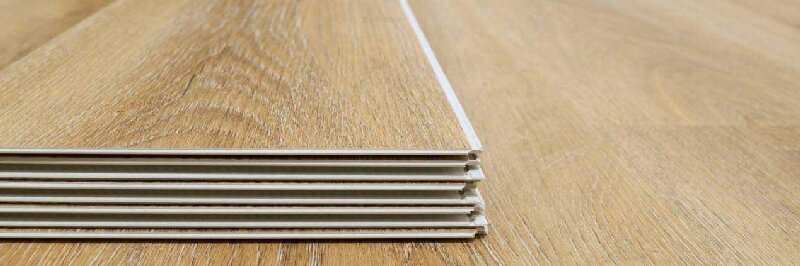
An SPC subfloor should be flat, dry, clean, structurally sound and stable. “Waterproof SPC” describes the flooring product; it does not remove the need to test the substrate or manage moisture below the floor. If the surface is outside the exact product tolerance, correct it before clicking planks together.
Most installation failures linked to the substrate start with one of four conditions. A practical inspection should separate them instead of treating “level floor” as a single checkbox.
Use a long straightedge or laser to locate humps, ridges and depressions. The floor does not need to be perfectly level in the geographic sense, but it must be sufficiently flat for the locking system.
Concrete, screed and wood should meet the moisture limits for the exact flooring system and local installation standard. Visual inspection alone is not a moisture test.
Loose panels, flexing plywood, moving tiles, weak screed and hollow repairs can transfer movement into the click joints. Fix structural instability before underlayment or flooring is added.
Remove grit, plaster, fastener heads, old adhesive residue and loose contamination. Small debris can create point loading, noise and localized rocking beneath a rigid plank.
Flat is not the same as level. A gently sloped but consistently flat substrate may behave very differently from a “level” floor with sharp local dips and ridges. The flooring manual controls the permitted flatness variation.
SPC installation guides from different brands use different measurement spans and tolerances. That is why a technically accurate project specification should identify the exact SKU, click system and installation document instead of relying on a generic internet rule.
| Question | What the Project Team Should Do | Why It Matters |
|---|---|---|
| How flat must the substrate be? | Measure with the straightedge length and tolerance stated in the approved product manual. Record high and low spots before installation. | Different manufacturers publish different limits; the specific product requirement controls warranty and installation risk. |
| Can a thicker SPC plank bridge dips? | No design decision should assume thickness will compensate for an out-of-tolerance substrate. Patch low areas and grind or sand high areas as appropriate. | Unsupported movement can load the locking edges repeatedly and cause noise, gaps or joint damage. |
| Can underlay act as a leveler? | Use only approved underlayment for acoustic or vapor-control functions. Do not use soft foam to hide subfloor defects. | Excess compression can increase vertical deflection beneath the click system. |
| Does waterproof SPC eliminate moisture checks? | No. Test and manage the substrate according to project conditions, slab location and the flooring manual. | Moisture can affect the environment beneath the floor, trims, adhesives, adjacent materials and indoor conditions even when the SPC core itself does not swell. |
Rigid core is sometimes misunderstood as “self-correcting.” It is not. SPC resists bending better than flexible vinyl, which is useful for dimensional stability, but that same rigidity means the plank needs continuous, controlled support.
When a low spot sits below a floating plank, foot traffic can repeatedly push the plank downward. At a ridge, adjoining boards can be forced to pivot around a high point. Both conditions transfer stress to short-side and long-side locking profiles.

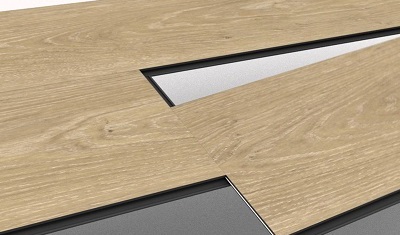
Choose the correction method by substrate type and defect—not by convenience. Repair materials should be compatible with the base, fully cured and suitable for the intended flooring system.
Concrete ridges may require grinding; wood seams may require sanding or approved mechanical correction. Recheck the area with the same straightedge method after repair.
Use a compatible patching or leveling compound where required. Feather edges smoothly and respect cure time, primer requirements and maximum build depth.
Re-secure loose plywood or OSB, repair weak screed and address unstable existing floor coverings. A leveler placed over a moving base does not solve the underlying problem.
Installation shortcut to avoid: adding a thick or soft underlay because a floor is uneven. Acoustic cushioning and subfloor leveling are different functions. For attached-pad SPC, do not stack a second soft layer unless the product instructions explicitly approve it.
The SPC core is designed for moisture-resistant interior use, but the substrate below it still needs a moisture plan. Concrete can transmit water vapor. Crawl spaces can introduce ground moisture. Wood can be damaged when moisture is trapped by the wrong assembly.
Test the slab with the method required by the specification or local standard. Depending on grade level, test results and product instructions, an approved polyethylene vapor barrier, integrated vapor-control underlay or surface-applied moisture system may be required.
Check moisture content, structural movement, ventilation and the condition of the crawl space or supporting assembly. Do not automatically trap a wood substrate between impermeable layers; follow the engineered moisture strategy for the building.
Existing tile, resilient flooring or other hard surfaces can sometimes remain when they are securely bonded, flat, dry and compatible. Moisture risk below the existing layer still needs to be understood rather than assumed away.
| Moisture-Control Question | Good Specification Practice |
|---|---|
| Which test? | Use the test method required by the flooring manual, project specification or relevant regional standard. Concrete RH and moisture-vapor emission testing are common approaches. |
| What result is acceptable? | Use the limit for the exact flooring system. Do not transfer a threshold from another manufacturer's guide to a 3C-Floor SKU without confirmation. |
| Is 6-mil poly always mandatory? | Many rigid-core systems specify a polyethylene vapor retarder over concrete, but requirements vary. Confirm membrane thickness, seam treatment and compatibility for the chosen product. |
| Does attached IXPE/EVA replace a vapor barrier? | Not automatically. An acoustic pad and a vapor-control layer serve different purposes unless the tested/approved construction explicitly combines both functions. |
SPC is renovation-friendly because many floating systems can be installed over several hard substrates. “Can be installed over” should still mean “after inspection and preparation.”
| Subfloor | Usually Possible? | Key Checks Before Installation |
|---|---|---|
| Concrete / screed | Yes, for compatible floating SPC systems. | Flatness, curing condition, cracks, contamination, moisture test, vapor-control requirement, transitions and perimeter movement space. |
| Plywood / OSB | Yes, when structurally suitable. | Panel thickness and support, fastener security, seam height, flexing/squeaks, moisture content, crawl-space condition and surface flatness. |
| Ceramic / stone tile | Often, if stable and flat. | Loose tiles, cracked areas, lippage, deep grout lines, floor-height changes and moisture conditions below the tile assembly. |
| Existing resilient flooring | Sometimes. | Must be hard, secure, compatible and not excessively cushioned. Investigate hazardous legacy materials before sanding or disturbance. |
| Carpet / soft cushion | Generally no for standard click SPC. | Remove the soft layer and prepare the structural substrate. Excessive compression can destabilize click joints. |
| Radiant-heated base | Possible for approved systems. | System type, heat-up protocol, maximum surface temperature, slab moisture and the exact SPC product instructions. |
For distributors and project buyers, subfloor risk should be discussed before approving thickness, backing and installation instructions. A product that sells well in a dry residential retrofit may not be the right construction for a concrete-on-grade commercial project.
3C-Floor can configure SPC rigid-core programs with different total thicknesses, wear layers, surface textures, click-lock options and attached backing. Typical product directions include IXPE, EVA or cork backing, plus OEM packaging and documentation for brands and distributors.
For B2B supply, an installation sheet is not an afterthought. It is part of product risk control. Before a distributor, developer or contractor releases material to the jobsite, the product and substrate assumptions should be aligned.
Record total construction, wear layer, backing, click profile, plank format, surface and carton code. Installation guidance should match that product—not a generic SPC category.
Identify the base, flatness method, moisture test, repair products, grade level, transitions, perimeter gaps and any underfloor-heating requirements.
Retain moisture records, photos, test locations, repair notes and approved product instructions. Clear records help separate substrate, installation and product issues if a claim occurs later.
Use these six related pages to move from substrate preparation into product construction, underlayment, durability and purchase planning.
SPC flooring needs a flat and stable base, but there is no single universal tolerance for every product. Manufacturer guides use different allowable variations and measurement spans. Follow the exact installation manual for the approved SKU, measure the full area and correct locations that exceed that requirement.
Only minor variation within the stated product tolerance should remain. Significant dips, humps or flexing areas should be repaired. Rigid SPC does not safely bridge major unevenness; repeated deflection can create clicking sounds, open seams and stress in the locking profile.
It depends on the substrate, grade level and flooring instructions. Concrete installations often require or benefit from an approved vapor-control layer. Wood assemblies require a moisture approach that does not trap moisture incorrectly. Waterproof SPC itself is not a substitute for subfloor moisture management.
No. Underlayment is not a leveling compound. A soft or overly thick pad can create extra movement and increase load on click joints. Correct high and low areas first, then install only the underlayment approved for the chosen SPC construction.
Often yes when the existing surface is hard, firmly bonded, flat, dry and compatible with the flooring system. Loose tiles, severe lippage, deep grout depressions, soft cushioned floors and damaged areas should be corrected or removed. Always follow the exact installation instructions.
Send the application, subfloor type, grade level, moisture-control plan, desired thickness, wear layer, plank size, attached backing, click system, décor direction, quantity, packaging requirement, destination and any required compliance documents. The more complete the project brief, the easier it is to match the flooring to real installation conditions.
Send 3C-Floor your subfloor condition and commercial target together with the product specification. We can help you organize a practical SPC construction for distributor, OEM, private-label and project supply.