Value-oriented WPC with controlled build height
Useful when distributors want WPC comfort and waterproof positioning while controlling material use, carton economics and transition height. Confirm whether the quoted 5.5mm includes backing.
WPC flooring thickness is a product-architecture decision, not a shortcut for judging quality. For distributors, importers, flooring brands, contractors and project buyers, the useful question is how total thickness works with the wear layer, WPC core, click profile, attached backing, finished floor height and target sales tier. 3C-Floor currently lists 5.5mm, 6.0mm, 6.5mm and 7.5mm as common WPC thicknesses, while published guidance places WPC generally around 5.5–8mm. A 7mm or exact 8mm WPC flooring build should therefore be confirmed against the selected structure rather than assumed to be a standard SKU.
A WPC thickness number is the sum of a layered flooring system. Buyers should confirm which layers are included in the quoted total thickness.
Direct answer for buyers
Choose the thinnest construction that still delivers the product position, comfort, locking-system support, finished floor height and backing strategy your market needs. Moving from 5.5mm toward 7.5mm or an 8mm WPC flooring target can create a more substantial product story, but thickness alone does not define wear resistance, indentation behavior, acoustic results or commercial suitability.
A value residential line may prioritize a controlled 5.5mm or 6.0mm build. A mainstream dealer, apartment or hospitality program may move toward 6.5mm or 7.5mm when comfort, attached backing and a more substantial sample-board presentation are part of the offer. If your market specifically asks for 7mm WPC or 8mm WPC flooring, treat the number as an RFQ target and confirm the exact layer stack before price comparison.
For the broader product construction and available WPC program context, review 3C-Floor’s WPC vinyl flooring range.
Thickness-by-thickness comparison
The ranges below are procurement directions rather than universal performance grades. 3C-Floor’s current WPC category lists 5.5mm, 6.0mm, 6.5mm and 7.5mm. Its published technical content also describes WPC floors generally in the 5.5–8mm range. For this reason, 7mm and an exact 8mm build should be confirmed for the chosen SKU and layer structure.
Useful when distributors want WPC comfort and waterproof positioning while controlling material use, carton economics and transition height. Confirm whether the quoted 5.5mm includes backing.
Provides more total build than 5.5mm and can support a stronger comfort-led retail or project story. Wear layer and backing still need separate specification.
Do not assume every 7mm quote contains the same core and pad split. Ask the supplier to state each layer so comparisons are technically meaningful.
Well suited to programs where a substantial plank feel, attached-pad story and premium sample presentation matter. Confirm finished-floor transitions early.
8mm WPC flooring can be a useful premium-market request, but the final build should be validated for core, backing, click geometry, packing and project height.
| Target Thickness | 3C-Floor Planning Status | Best Buying Logic | What to Verify | Common Sourcing Risk |
|---|---|---|---|---|
| 5.5mm WPC | Listed as a common WPC thickness | Value-to-mainstream residential, renovation or distributor programs where total build height and landed cost matter | Pad included or excluded, click-joint support, wear layer, edge profile | Comparing a bare 5.5mm plank with a 5.5mm “including pad” plank as if they were identical |
| 6.5mm WPC | Listed as a common WPC thickness | Mainstream dealer, apartment, hospitality and private-label programs that need a more substantial product story | Core/pad split, wear layer, plank format, carton weight, transition height | Paying for added thickness without defining where the added material is placed |
| 7mm WPC | Project / custom confirmation recommended | Market-specific tenders or retail lines where “7mm” is already a required selling specification | Exact approved layer stack, click-system compatibility, backing, sample and technical sheet | Assuming 7mm is a universal standard construction across factories |
| 7.5mm WPC | Listed as a common WPC thickness | Comfort-forward and premium-mainstream WPC ranges, including attached-pad private-label programs | Door clearances, transitions, core balance, pad density, pallet/loading plan | Overspecifying thickness when the market would value a better wear layer, surface or design more |
| 8mm WPC flooring | Within general published WPC range; exact construction to confirm | Premium thickness positioning or projects explicitly written around an 8mm target | Factory feasibility, complete layer stack, joint geometry, backing, packing and final sample | Assuming “thicker” automatically means more durable or more commercial |
Specification note: 3C-Floor also lists 6.0mm among its common WPC product thicknesses. This page emphasizes the requested 5.5mm, 6.5mm, 7mm, 7.5mm and 8mm search intents while retaining 6.0mm as a valid quotation option where relevant.
Understand the number
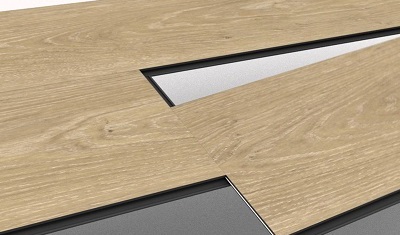
Two WPC planks can both be advertised as “7.5mm” and still be materially different products. One may allocate more thickness to the WPC core; another may use a thinner core with a thicker attached pad. A buyer should therefore approve the complete layer stack rather than treating one headline number as the full specification.
Total thickness = upper vinyl structure + WPC core + attached backing (if included).
That equation matters because the pad beneath the plank has a different job from the core and the transparent wear layer above the décor. For attached-pad programs, use the WPC backing guide for EVA, IXPE and cork to decide how the underlay fits the intended product tier.
Performance logic
Overall thickness influences product feel, floor height, material volume and merchandising position, but it cannot substitute for the wear layer, core formulation, locking quality, backing support, surface finish, installation condition or maintenance plan. This is one of the most important distinctions when a purchasing team compares 5.5mm WPC with 7.5mm or 8mm WPC flooring.
| Buyer Question | What Thickness Can Influence | What Thickness Cannot Prove by Itself |
|---|---|---|
| Will it feel more substantial? | A thicker complete plank can create a more substantial underfoot and showroom impression. | It does not prove the backing density, core quality or acoustic result. |
| Will it resist surface wear longer? | Total thickness may support a higher product tier. | Surface wear is driven more directly by wear-layer specification, coating, texture, maintenance and traffic. |
| Will it handle heavy furniture better? | Core geometry can change with the build. | Indentation behavior cannot be predicted from millimeters alone. |
| Will it be quieter? | A thicker plank and resilient backing can contribute to a comfort/acoustic strategy. | No single thickness guarantees an IIC/STC or other acoustic result in every floor-ceiling assembly. |
| Is 8mm more commercial than 6.5mm? | 8mm can support premium positioning. | Commercial suitability still depends on wear layer, project traffic, substrate, maintenance and required tests. |
If your main decision is installation rather than thickness, the click lock WPC flooring guide explains why locking geometry, backing compression and subfloor preparation must be treated as one floating-floor system.
Product-line architecture
A distributor does not always need five near-identical WPC thicknesses. A stronger commercial strategy uses thickness as one part of a product ladder. The goal is to create clear reasons to trade up: better surface realism, stronger wear-layer direction, attached backing, wider plank proportions, richer décor and a more premium package—not just a bigger millimeter number.
Typical direction: 5.5mm or 6.0mm common construction, selected wear layer, efficient plank format and cost-conscious backing strategy.
Use this tier where the customer values WPC comfort and waterproof positioning but the channel is sensitive to landed cost and finished floor height.
Typical direction: 6.5mm common construction with an upgraded décor, lower-gloss surface, coordinated backing and a wear layer matched to the intended traffic.
This is a practical space for dealer lines, apartments, hotel guestrooms and brand programs that want a noticeable step-up without overbuilding the product.
Typical direction: 7.5mm common construction or an exact 8mm target by confirmation, paired with refined surface, backing and OEM presentation.
Use premium thickness only when the visual, acoustic, comfort and merchandising package supports the added product position.
Typical direction: specification-led project or retail requirement, confirmed as a custom or approved exact build.
For a 7mm request, define whether 7mm is the complete finished product, the board before backing, or a nominal market label before samples are prepared.

Décor and plank proportion often create more visible differentiation than an extra half millimeter. See WPC design options for oak, walnut and wide-plank programs when building a private-label assortment.
Common sourcing errors
Thickness disputes usually appear after samples or quotations because the parties were not using the same definition. These mistakes are avoidable if the RFQ states the complete construction before price comparison.
The same headline number can describe different layer stacks. Require the supplier to show the total and each component.
A thicker core does not replace the need to specify wear layer, coating and expected traffic.
Door clearance, adjacent tile, skirting and transition profiles can make a thicker plank inconvenient on site.
Backing must support the click system. More thickness is not automatically better if compression creates movement.
A décor approval should be tied to thickness, wear layer, backing, click profile, bevel and surface reference.
Keep a controlled SKU record so the second container matches the first in both appearance and technical build.
Application matching
The correct WPC thickness depends on the installed environment as well as the sales channel. The following directions help buyers shortlist a thickness tier, but the final SKU still needs application-specific wear layer, backing, subfloor and test-document review.
5.5mm to 6.5mm can be a useful starting area when minimizing build height and keeping installation practical are p, riorities. Check doors and adjacent flooring first.
6.5mm or 7.5mm may support a stronger comfort-and-backing story. Acoustic expectations should be verified on the complete assembly, not inferred from thickness.
Mid-to-thicker WPC programs can suit comfort-led interiors when décor, wear layer, attached pad and maintenance plan are coordinated for repeated room use.
Use 5.5mm, 6.5mm and 7.5mm to create visible price tiers only when each tier also changes a feature the customer can understand and value.
Choose by rolling loads, chair use, renovation height, acoustics and surface maintenance. A thicker WPC plank alone does not make an office specification complete.
7.5mm or an 8mm target can support premium merchandising when combined with wide-plank design, refined embossing, low-gloss finish and appropriate backing.
If a bill of quantities calls for 7mm or 8mm WPC, quote the exact layer stack and submit an approved sample so “nominal thickness” does not cause later disagreement.
When the project needs more rigidity or lower build height, compare WPC with SPC rather than forcing a thicker WPC structure into the wrong use case.
For a category-level comparison of core feel and positioning, use the SPC vs WPC waterproof flooring comparison.
Installed-floor thinking
End customers rarely value 6.5mm or 7.5mm as isolated engineering numbers. They notice whether the plank feels substantial, the surface looks believable, footsteps sound controlled, the edges sit cleanly, the floor transitions well to adjacent materials and the décor remains consistent across the room.
That is why a thickness page should lead to a complete product brief. For OEM and private-label programs, 3C-Floor can coordinate thickness with wear layer, décor, embossing, click system, backing and packaging. A factory discussion is most productive when the target market and price tier are shared before the sample is locked.
Buyers evaluating supply capability can continue to the WPC flooring manufacturer and OEM supply page.
OEM development
The safest workflow is to lock the commercial purpose first and the millimeter number second. This avoids a common sourcing problem: requesting “8mm WPC” before the buyer has decided whether the value should come from the core, pad, wear layer, surface or design.
Country, channel, buyer type, application and target price tier.
Choose 5.5, 6.5, 7, 7.5 or 8mm target and define whether backing is included.
Confirm wear layer, core, resilient layers and backing rather than only the total.
Check joint fit, plank feel, color, emboss, bevel, backing adhesion and dimensions.
Freeze technical sheet, carton marks, labels, sample reference and QC checkpoints.
Quotation-ready specification
A good RFQ lets 3C-Floor quote the same product you intend to sample and order. It also makes supplier comparison faster because each factory is answering the same technical brief.
Buyer FAQ
Short answers for sourcing teams comparing 5.5mm WPC, 6.5mm WPC, 7mm WPC, 7.5mm WPC and 8mm WPC flooring.
There is no universal best WPC thickness. The right specification depends on the complete plank construction, wear layer, backing, click system, finished floor height, traffic level and price position. 3C-Floor currently lists 5.5, 6.0, 6.5 and 7.5mm as common WPC thicknesses, while other structures should be confirmed for the selected program.
5.5mm WPC can be a practical value-oriented specification when the core, wear layer, click profile and backing are engineered as a complete system. It should not be selected from thickness alone; the target application and finished construction still need to be confirmed.
A 7.5mm WPC program provides more total build height than a 6.5mm program, but that does not automatically mean a stronger wear surface. Buyers should compare how much of the total thickness comes from the core, vinyl layers and attached backing, and should choose the wear layer separately according to traffic.
7mm WPC should be treated as a project-confirmed or custom construction unless the selected SKU is specifically approved at that thickness. Send the required total thickness, wear layer, backing, size and application so 3C-Floor can confirm feasibility.
3C-Floor’s published information describes WPC plank thickness generally up to about 8mm, but the current standard WPC category lists 5.5, 6.0, 6.5 and 7.5mm. An exact 8mm WPC flooring construction should therefore be confirmed for the chosen core, backing, click system and project.
No. Overall plank thickness and wear-layer thickness are different specifications. A thicker WPC core can change feel, product positioning and finished floor height, while the wear layer is selected primarily around surface traffic and durability expectations.
Send the target total thickness, wear layer, plank size, décor, surface, click system, backing type and thickness, application, target market, quantity, packaging requirements, certification or testing needs and destination port.
Tell 3C-Floor whether your market is asking for 5.5mm WPC, 6.5mm WPC, 7mm WPC, 7.5mm WPC or 8mm WPC flooring, then add the wear layer, backing, décor, size, application and target market. The result is a quotation that can move directly toward sampling and an approved repeat-order specification.